 Written by Hirotsugu Suwanai, MD, PhD
Journal Club of the Suwanai · Diabetes Drugs & Real-world Data
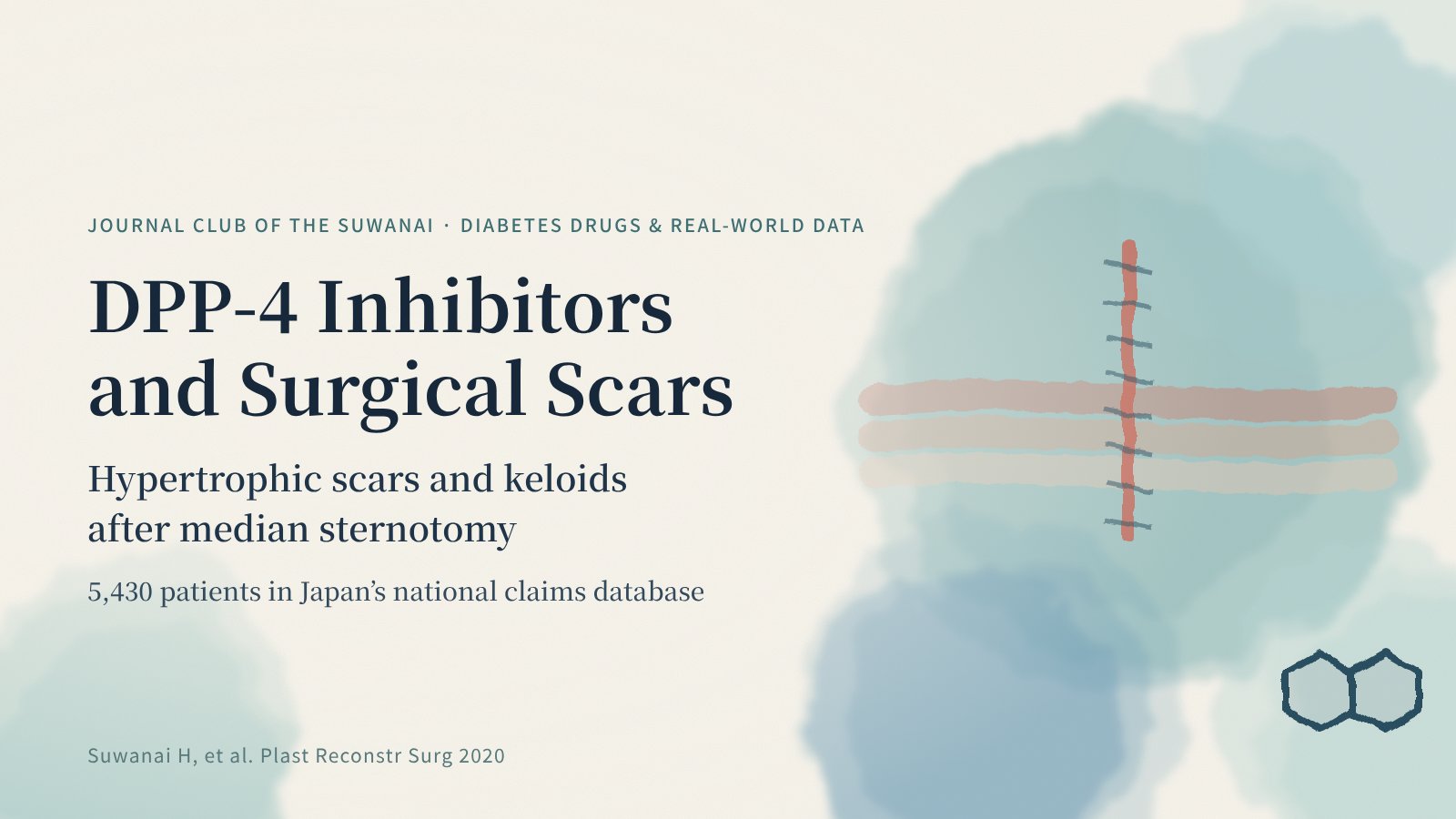
Hypertrophic scars and keloids — raised, red surgical scars — depend largely on individual predisposition, and there is still no reliable way to prevent them. A diabetes drug may offer a clue.
In 2020, Plastic and Reconstructive Surgery published our study examining DPP-4 inhibitors and postoperative hypertrophic scars and keloids using Japan’s National Database of Health Insurance Claims and Specific Health Checkups (NDB). It was a collaboration with plastic surgeons, and I was the first author. Read the original paper ↗
Key point: looking at a diabetes drug for a different purpose ↓
Why DPP-4 inhibitors?
Hypertrophic scars and keloids arise when fibrosis runs out of control during wound healing. DPP-4 is known in diabetes care as the enzyme that degrades incretin hormones, but it has also been linked to fibroblast activity and fibrosis. That raised the possibility that DPP-4 inhibitors could curb scar fibrosis.
Methods: following surgical patients nationwide
From NDB data between April 2013 and March 2015, we identified patients who underwent median sternotomy (the midline chest incision used in heart surgery) by procedure codes. Those prescribed DPP-4 inhibitors within one year before surgery formed the treatment group; others formed the non-treatment group.
Results: fewer scars with DPP-4 inhibitors
Fewer than 10 cases (<2%) in the treated group. Source: Suwanai et al., Plast Reconstr Surg (2020).
The cohort included 5,430 patients across Japan (3,509 men and 1,921 women). Among 446 patients treated with DPP-4 inhibitors, fewer than 10 (<2%) developed hypertrophic scars or keloids, compared with 152 of 4,984 untreated patients (3.05%; p = 0.04). Logistic regression adjusting for confounders was also performed.
Journal Club view: looking at a diabetes drug for a different purpose
This is an example of searching for new effects of existing drugs in nationwide real-world data. Because the NDB covers nearly all insured care in Japan, even uncommon outcomes can be studied in large numbers.
Claims data have limits. Scars were identified from diagnosis and procedure records, so mild cases may be missed. Patients on DPP-4 inhibitors have diabetes, and differences in glycemia or other treatments may have influenced the result. NDB publication rules also prevent reporting counts below 10. Prospective studies and mechanistic work are needed to confirm the finding.
Looking ahead
Scarring affects quality of life and appearance. The idea that a diabetes drug might help control fibrosis — an entirely different field — is an intriguing case of drug repositioning.
Related articles
REFERENCE
Suwanai H, Watanabe R, Sato M, Odawara M, Matsumura H. Dipeptidyl Peptidase-4 Inhibitor Reduces the Risk of Developing Hypertrophic Scars and Keloids following Median Sternotomy in Diabetic Patients: A Nationwide Retrospective Cohort Study Using the National Database of Health Insurance Claims of Japan. Plast Reconstr Surg. 2020;146(1):83–89.
doi:10.1097/PRS.0000000000006904 ↗
This article is an independent English summary and commentary based on the original paper. No figures are reproduced.