 Written by Hirotsugu Suwanai, MD, PhD
Journal Club of the Suwanai · Pediatric Endocrinology & Genetics
Differences of sex development (DSD) are conditions in which the development of sex chromosomes, gonads or genitalia differs from the typical course. Causes are diverse, and finding the diagnosis remains a major clinical challenge.
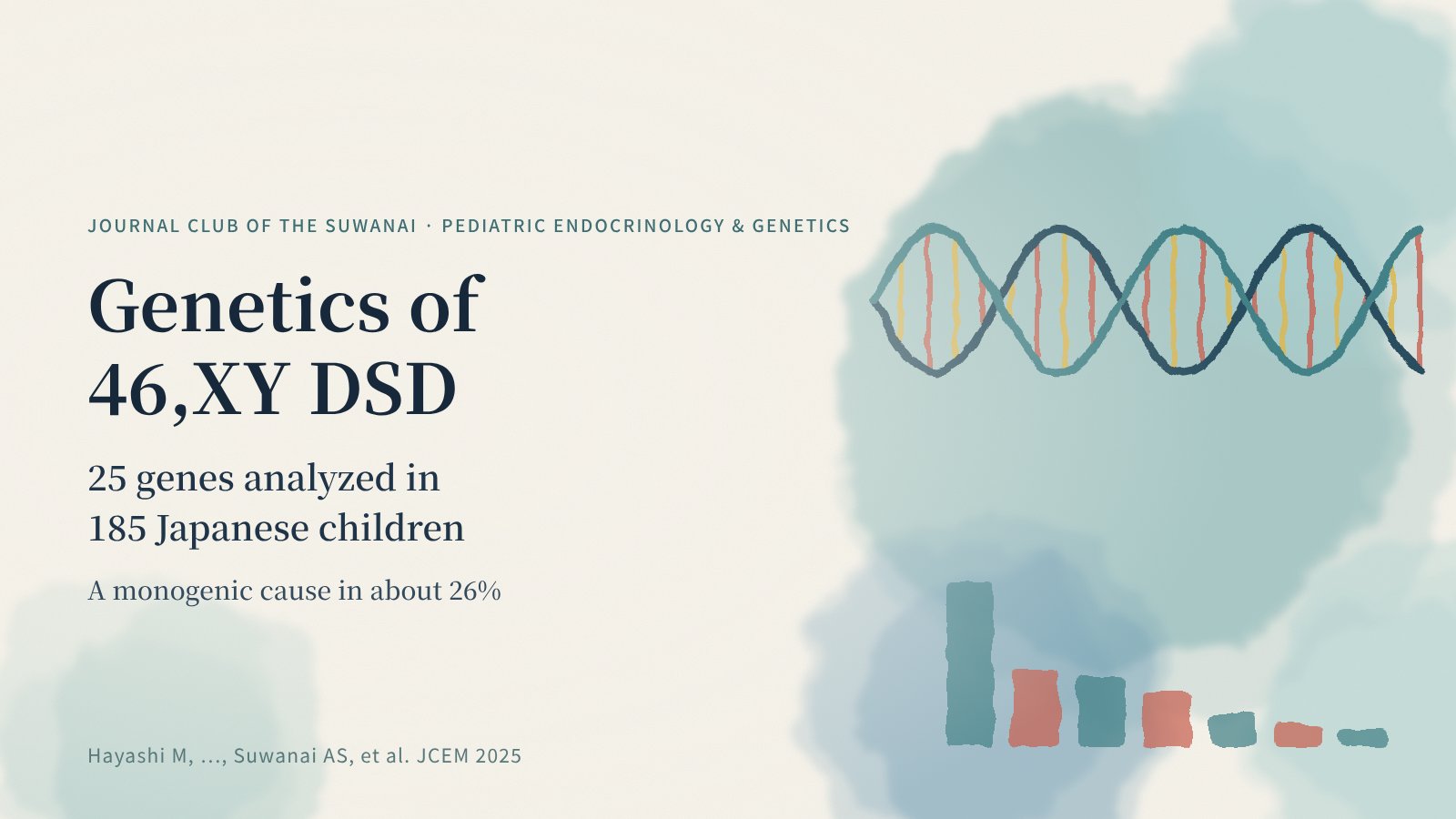
In 2025, the Journal of Clinical Endocrinology & Metabolism (JCEM) published a genetic study of 185 Japanese children with 46,XY DSD. It was a multicenter study in Japan, and Ayuko S. Suwanai took part as a co-author. Read the original paper ↗
Key point: phenotype clues that predict a genetic diagnosis ↓
Aim and methods
46,XY DSD has many causes, and it has been unclear how often a single-gene (monogenic) disorder is responsible and what clinical picture each one produces.
The team sequenced 25 genes linked to 46,XY DSD in 185 patients from 178 families. Variant pathogenicity was assessed according to American College of Medical Genetics and Genomics (ACMG) guidelines, supplemented by in silico and in vitro analyses. They then related the genetic findings to external and internal genital features.
A monogenic cause in about 26%
Source: Hayashi et al., J Clin Endocrinol Metab (2025).
A monogenic disorder was identified in 51 patients (47 families), about 26% of the cohort. The androgen receptor gene AR (11%) was most common, followed by SRD5A2 (4.5%), NR5A1 (4.0%), SRY (2.8%), WT1 and STAR (1.1% each), and CYP17A1, HSD3B2 and MAP3K1 (0.56% each).
Journal Club view: phenotype clues that predict a genetic diagnosis
The most practical message concerns which findings make a genetic diagnosis more likely:
- When Müllerian derivatives (such as a uterus) were detected, a monogenic cause was found in 57%, versus 26% when they were not.
- When the external genitalia were female-typical, the yield was 91%, versus 19% with ambiguous genitalia.
In other words, the more severely masculinization of the genitalia is affected, the more likely a single-gene cause is found. Conversely, many children with ambiguous genitalia remain unexplained by these 25 genes, pointing to other genes, multifactorial causes or the intrauterine environment.
The results depend on the gene panel and the criteria used to classify variants, and they come from a Japanese population — points to keep in mind when applying them elsewhere.
Why it matters for care and families
Knowing the genetic cause informs hormone therapy, gonadal management, future fertility and genetic counseling for families. As a large dataset from Japan, the study helps clinicians decide which tests to order and in what sequence.
REFERENCE
Hayashi M, Narumi S, Sato T, Amano N, Suwanai AS, Haruna H, Muroya K, Adachi M, Asanuma H, Ohashi H, Ishii T, Hasegawa T. Genetic and Clinical Characteristics of 185 Japanese Children With 46,XY Differences of Sex Development. J Clin Endocrinol Metab. 2025;110(8):e2682–e2690.
doi:10.1210/clinem/dgae813 ↗
This article is an independent English summary and commentary based on the original paper. No figures are reproduced.