 Written by Hirotsugu Suwanai, MD, PhD
Journal Club of the Suwanai · Diabetes & Neurology
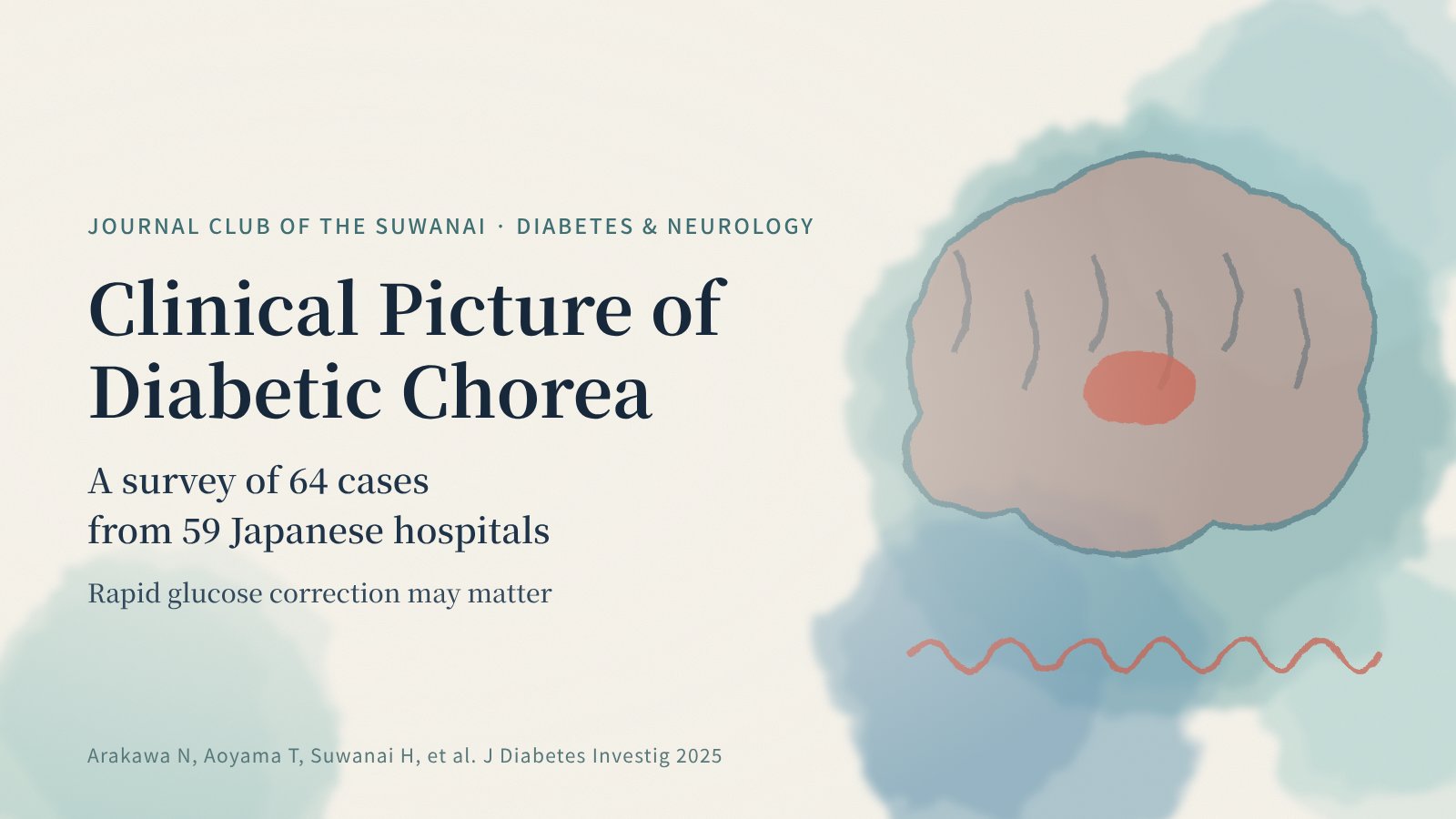
Chorea is a movement disorder in which the limbs move involuntarily. It can appear suddenly in people with diabetes — a condition called diabetic chorea.
In 2025, the Journal of Diabetes Investigation published a nationwide survey of diabetic chorea cases reported in Japan, in which I took part as a co-author. Because the condition is rare, few hospitals see many cases, so the team sent questionnaires to the institutions that had published case reports. Read the original paper ↗
Key point: the risk of lowering glucose too quickly ↓
What is diabetic chorea?
Diabetic chorea refers to sudden involuntary movements in people with diabetes, usually on a background of severe hyperglycemia. MRI or CT may show characteristic signal changes in the basal ganglia, such as the putamen.
Methods: a survey of reporting institutions
The investigators searched PubMed and Ichushi (a Japanese medical database) for case reports on “diabetes” and “chorea” published from 2012 to 2017 and sent questionnaires to the reporting institutions, collecting data on 64 cases.
Results: about one in five triggered by hypoglycemia or glucose improvement
Source: Arakawa et al., J Diabetes Investig (2025).
Most patients were older adults with type 2 diabetes and severe hyperglycemia at onset. However, in 14 cases (21.9%), hypoglycemia or improvement of plasma glucose triggered the symptoms.
Thirty-nine patients (60.9%) remitted within six months, while 25 (39.1%) had prolonged partial remission. The prolonged group more often had widespread involuntary movements, typical imaging findings, and onset after starting antidiabetic treatment, including hypoglycemia.
Journal Club view: the risk of lowering glucose too quickly
Diabetic chorea has been framed as a disease of hyperglycemia. This study suggests that rapid glucose correction and hypoglycemia may also influence onset and prognosis. Lowering glucose in severe hyperglycemia is necessary, but its pace may deserve attention — an idea that echoes the early worsening of diabetic retinopathy after rapid glycemic improvement.
Because the data come from institutions that published case reports, the sample may be biased toward “reportable” cases. The study cannot tell us how common the condition is or what rate of glucose lowering is safe.
Practical tips
When an older person with diabetes suddenly develops involuntary limb movements, check not only for hyperglycemia but also for recent treatment changes or hypoglycemic episodes. For a rare disease, pooled multicenter data like these are a valuable guide to diagnosis and management.
Related articles
REFERENCE
Arakawa N, Aoyama T, Suwanai H, Toda G, Takamoto I, Okazaki Y, Kadowaki T, Yamauchi T. Elucidation of the clinical traits of diabetic chorea through a questionnaire survey of people with diabetic chorea from 59 Japanese hospitals. J Diabetes Investig. 2025;16(4):680–688.
doi:10.1111/jdi.14392 ↗ / Full text (PMC) ↗
This article is an independent English summary and commentary based on the original paper. No figures are reproduced.