 Written by Hirotsugu Suwanai, MD, PhD
Journal Club of the Suwanai · Thyroid & Genetics
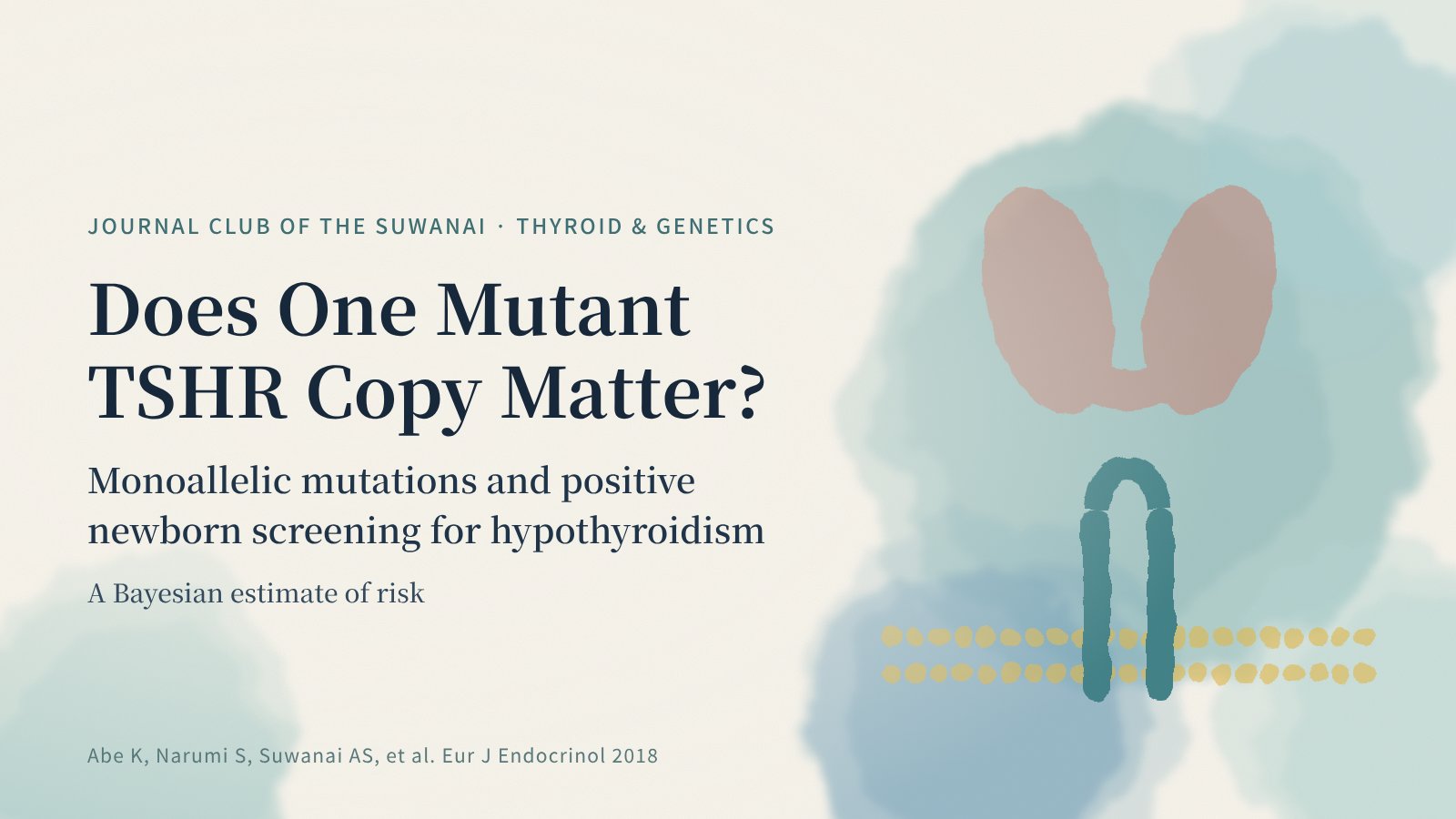
Many genetic conditions are recessive: disease appears only when both copies of a gene are altered. But do carriers with just one altered copy truly have no effect?
In 2018, the European Journal of Endocrinology published a statistical analysis of monoallelic TSH receptor (TSHR) mutations and positive newborn screening for congenital hypothyroidism (CH). Ayuko S. Suwanai took part as a co-author. Read the original paper ↗
Key point: odds ratios versus real-world probabilities ↓
Background: an unclear effect in carriers
TSHR is the receptor that receives pituitary TSH and drives thyroid hormone production. Biallelic TSHR mutations cause CH, but carriers of one mutated copy have TSH levels ranging from normal to mildly elevated, so the size of their effect was uncertain.
Methods: 395 patients and a Bayesian estimate
TSHR was sequenced in 395 newborns with positive CH screening. Monoallelic carriers were further sequenced for DUOX2, which encodes an enzyme producing the hydrogen peroxide needed for thyroid hormone synthesis. Mutation function was verified in vitro, and frequencies were compared with theoretical values for the Japanese general population. Using Bayes’ theorem, the authors estimated the probability that a newborn carrying a mutation screens positive.
Results: carriers were clearly over-represented
Source: Abe et al., Eur J Endocrinol (2018).
Twenty-six patients (6.6%) were monoallelic TSHR carriers, far above the estimated 0.58% in the general population. Four also carried a monoallelic DUOX2 mutation (“double heterozygotes”; 1.0% vs 0.0087%). Odds ratios for positive screening were 12.0 and 117.9, respectively.
Journal Club view: odds ratios versus real-world probabilities
Odds ratios of 12 or 118 sound alarming. Yet the Bayesian posterior probability of positive screening was 0.38% for TSHR carriers and 3.8% for double heterozygotes. Most carriers never screen positive. A strong association is not the same as a high probability — and in genetic counseling, the latter is what families need.
The finding that two gene variants compound each other supports the view that CH is not always a simple single-gene disease but can arise from combinations of genetic factors. The study population was Japanese, and results may vary with screening cut-offs.
Clinical message
CH detected by newborn screening may reflect monoallelic variants or combinations across genes. When explaining genetic results to families, separating relative risk from absolute probability is essential.
Related articles
- Twelve “Bridges” That Hold Thyroid Peroxidase Together: Disulfide Bonds and Congenital Hypothyroidism
- A Monogenic Cause in About One in Four Children with 46,XY DSD: Genetic Analysis of 185 Japanese Patients
REFERENCE
Abe K, Narumi S, Suwanai AS, Adachi M, Muroya K, Asakura Y, Nagasaki K, Abe T, Hasegawa T. Association between monoallelic TSHR mutations and congenital hypothyroidism: a statistical approach. Eur J Endocrinol. 2018;178(2):137–144.
doi:10.1530/EJE-16-1049 ↗
This article is an independent English summary and commentary based on the original paper. No figures are reproduced.