 Written by Hirotsugu Suwanai, MD, PhD
Journal Club of the Suwanai · Diabetes & Infection
Diabetes is a well-known risk factor for severe COVID-19. But once a patient is admitted, when and how does the illness tend to worsen?
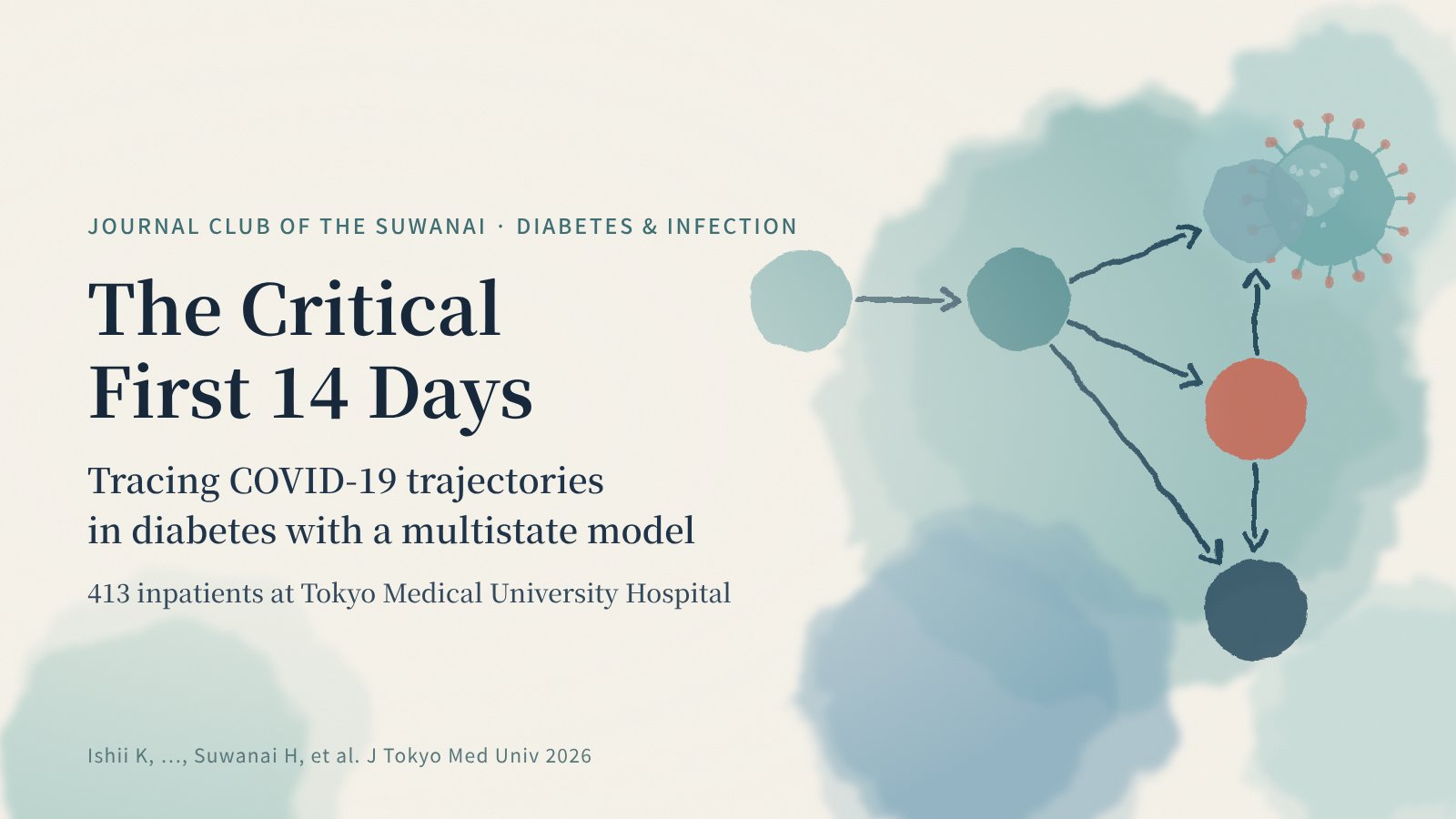
In January 2026, The Journal of Tokyo Medical University published our study tracing the hospital course of patients admitted with COVID-19 using a multistate model. I served as the corresponding author. Our earlier multicenter study of about 10,000 inpatients asked “how much higher is the risk?” This study asks a different question: “when, and at which stage, does the risk rise?” Read the original paper ↗
Key point: what kidney function explains — and what it does not ↓
Patients and methods: detailed data from one hospital
We studied 413 patients admitted to Tokyo Medical University Hospital with COVID-19 between March 2020 and October 2021; 123 had diabetes (5 type 1, 118 type 2). Unlike claims data, our dataset included admission laboratory results, SpO2, CT findings and kidney function (eGFR).
Alongside conventional logistic regression, we used a continuous-time multistate Markov model that follows patients through onset → hospitalization → ICU → general ward → discharge or death. Stacked probability plots show the chance of being in each state at each point in time.
Patients with diabetes arrived sicker
Compared with controls, patients with diabetes were older (mean 61.8 vs 50.0 years), more often had hypertension (59.3% vs 26.6%) and chronic kidney disease (36.6% vs 8.3%), and had higher glucose and CRP at admission. Their mean eGFR was 57.3, versus 76.9 in controls.
Source: Ishii et al., J Tokyo Med Univ (2026), Table 1.
In unadjusted comparisons, ICU admission, intubation, ARDS, acute kidney injury (AKI), continuous hemodiafiltration (CHDF) and death were all more frequent with diabetes. In-hospital mortality was 8.1% (vs 2.8%), and the composite of ICU admission or death occurred in 33.1% (vs 10.3%).
Deterioration came earlier
In the stacked plots, the ICU and death areas were larger at every time point in the diabetes group, and the gap opened mainly within 10–14 days of onset. Cumulative hazards for the transitions from hospitalization to ICU and from hospitalization to death rose earlier and more steeply with diabetes.
In Cox regression adjusted for age, sex, BMI, SpO2 and smoking, the hazard ratio for ICU transfer was 2.41 (95% CI 1.37–4.23). By contrast, recovery after ICU admission looked similar in both groups, suggesting that diabetes matters most during the phase of deterioration rather than recovery.
Journal Club view: what kidney function explains — and what it does not
The stepwise adjustment is the most instructive part of the paper. In Model B (age, sex, BMI, SpO2, smoking), diabetes remained associated with ICU admission (OR 2.22), ARDS and AKI. When admission eGFR was added in Model C, the associations with CHDF, ARDS, AKI and intubation were no longer significant.
This does not mean diabetes is irrelevant. Reduced kidney function may lie on the causal pathway (a mediator) or act as a confounder. Notably, the associations with ICU admission and the composite outcome persisted even after eGFR adjustment. In practice, risk in patients with diabetes should be assessed together with kidney function.
Limitations include the single-center design, a moderate sample size, and the pre-vaccine, pre-Omicron period. Obesity was excluded from some models because of collinearity with diabetes, and no cardiovascular index was included.
Clinical message
For people with diabetes admitted with an acute infection, the first two weeks deserve the closest attention, especially when kidney function is reduced. By choosing a method that models time and states, this study turns “there is a risk” into a more actionable “when and where to watch.”
Related articles
REFERENCE
Ishii K, Harada K, Iwasaki H, Hara N, Abe H, Shikuma J, Miwa T, Nakamura I, Watanabe H, Suwanai H, Suzuki R. Multi-state Model Analysis Reveals Increased Risk of Severe COVID-19 Outcomes in Hospitalized Patients with Diabetes. The Journal of Tokyo Medical University. 2026;84(1):39–49.
Tokyo Medical University Repository ↗
This article is an independent English summary and commentary based on the original paper. No figures are reproduced.