
 Written by Hirotsugu Suwanai, MD, PhD
Journal Club of the Suwanai · Obesity & Visceral Fat
Health check-ups in Japan measure waist circumference as a proxy for visceral fat. But the measurement varies with the examiner, posture and even breathing.
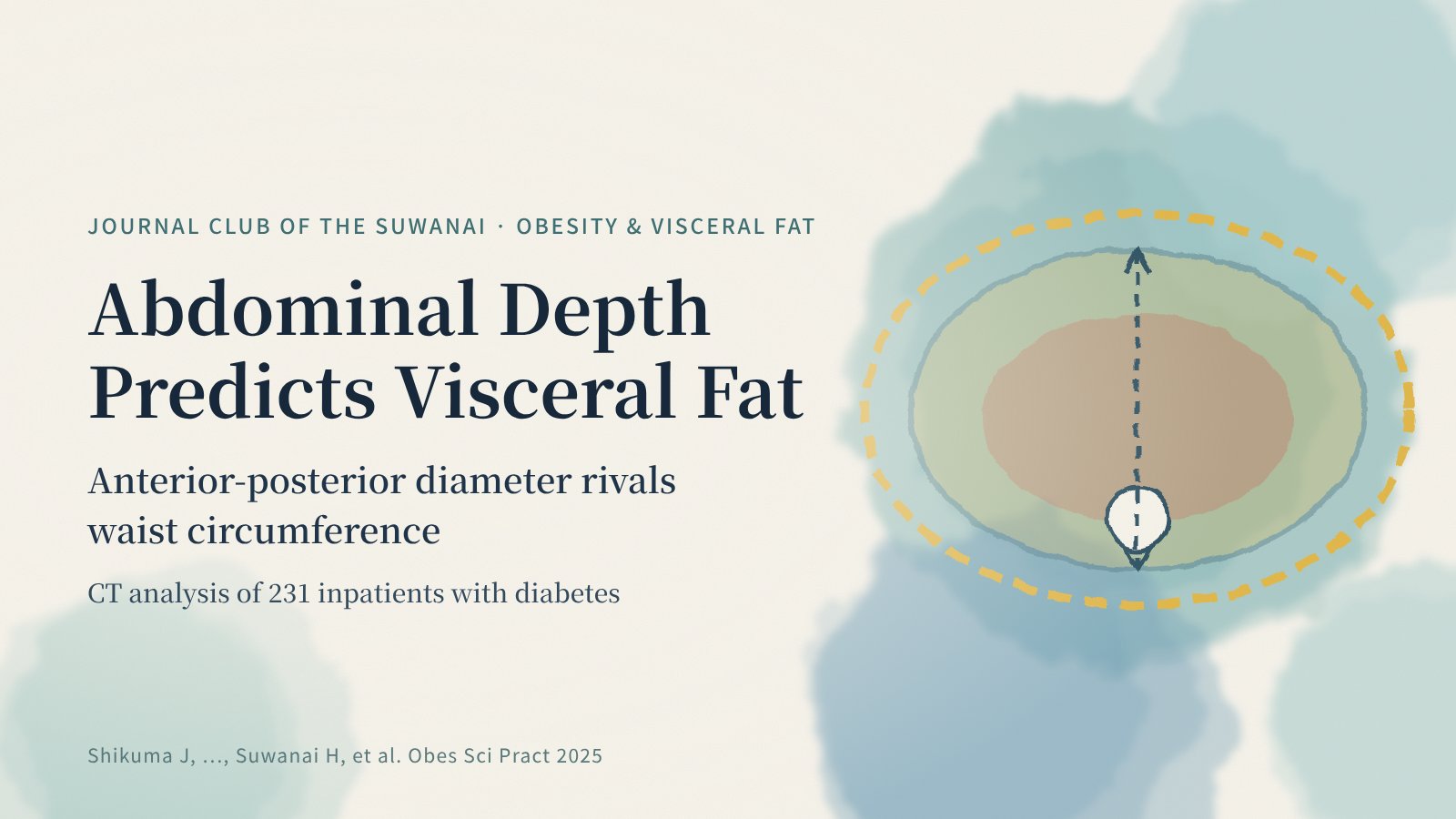
In 2025, Obesity Science & Practice published a study testing whether anterior-posterior abdominal diameter — the front-to-back depth of the abdomen — can predict visceral fat area as an alternative to waist circumference. The work came from our group at Tokyo Medical University, and I took part as a co-author. Read the original paper ↗
Key point: uses in occupational health and daily practice ↓
The idea
Visceral fat accumulates inside the abdominal cavity and, in excess, raises the risk of diabetes and cardiovascular disease. In people with a lot of visceral fat, abdominal CT at the level of the navel often shows the abdomen bulging forward. The investigators reasoned that this front-to-back depth could serve as a marker of visceral fat, just like waist circumference.
Methods
In 231 patients with diabetes admitted to Tokyo Medical University Hospital whose visceral fat area was measured by CT, the team compared how well waist circumference and anterior-posterior diameter correlated with, and predicted, visceral fat area.
Results: comparable predictive ability
Source: Shikuma et al., Obes Sci Pract (2025).
Visceral fat area correlated strongly with both waist circumference (r = 0.759) and anterior-posterior diameter (r = 0.774). The areas under the ROC curve for predicting visceral fat were 0.923 and 0.939, respectively — the abdominal diameter performed as well as waist circumference.
Journal Club view: uses in occupational health and daily practice
Because the diameter is measured as a front-to-back depth while lying supine, it may vary less than a tape wrapped around the waist, which depends on clothing and on whether the person has just inhaled or exhaled. A simpler, more reproducible measure would make visceral-fat risk easier to assess at check-ups and in clinics.
The participants were hospitalized patients with diabetes, so results need confirmation in the general check-up population. Standardizing the measurement and defining cut-off values are next steps, and current health-check rules still rely on waist circumference.
The value of a simple measure
Assessing visceral-fat risk without costly imaging matters for prevention. This practical study grew out of everyday clinical observation.
Related articles
REFERENCE
Shikuma J, Nagai Y, Otaki M, Shimizu N, Wada Y, Sasaki-Shima J, Suwanai H, Ito R, Miwa T, Suzuki R. Anterior-Posterior Abdominal Diameter and Waist Circumference Have Comparable Predictive Ability for Visceral Fat Area. Obes Sci Pract. 2025;11(1):e70047.
doi:10.1002/osp4.70047 ↗ / Full text (PMC) ↗
This article is an independent English summary and commentary based on the original paper. No figures are reproduced.